Showing posts with label Biographies. Show all posts
Tuesday, March 25, 2014
The First Autobiography Written in English, Ever
It's called Margery Kempe. There's only one book known to exist. It's now digitized.
From a piece in the Guardian...
Kempe lived in Norfolk from around 1373 to 1440. After she had given birth to 14 children, she made a vow to live chastely with her husband, and embarked on pilgrimages to Jerusalem, Santiago de Compostela, Italy and Germany. Her devotion was expressed through loud cries and roars, which often irritated bystanders, but she became famous as a mystic, and claimed to have conversations with God.
She dictated her life story to a priest, but her autobiography was only known through excerpts printed by Wynkyn de Worde in 1501, and by Henry Pepwell, who called her a "devoute ancres", in 1521, until a complete manuscript – thought to be a copy made from the original, possibly under Kempe's supervision – was discovered in a cupboard in the 1930s.
Wednesday, March 19, 2014
Sunday, April 28, 2013
Monday, February 25, 2013
Sleaze Lit
The Washington Times takes a look at those celebrity tell-alls, trashing the dead.
From the piece...
I slept with Marilyn Monroe.
Can you prove otherwise? That’s right. You can’t, and that’s my point.
Or, as they’d say around my home, “Too much information, Dad.”
I say the same about books that keep coming out about dead celebrities, told by people who were intimate with them, or so they say.
I do not need all that information.
Let me depart from books for a second to talk about a film that was made for HBO about Hemingway and Gellhorn, starring Clive Owen and Nicole Kidman. This was okay as these specials go, but I did not need those sex scenes, and I turned my head when I knew what was coming, a momentary glimpse of Owen’s back end, meant to convey Hemingway in heat, in addition to his posterior.
Thank you, but I don’t need that about an American legend. Nor do I need all those tell-alls that defame the reputations of people we revere and idolize.
Is this an American thing, this need to destroy our heroes? I call it Sleaze Lit.
Friday, December 21, 2012
The Life and Times of Madeleine L'Engle
Bookforum takes a look at the life of the A Wrinkle in Time author.
From the piece...
This is no tell-all: Published by Farrar,
Straus & Giroux, L’Engle’s longtime home, and featuring several of
her editors and publicists, the book has the feel of a Festschrift—a
celebratory volume in honor of one of the house’s most beloved writers.
(There is also a sense that certain scores are being settled: A number
of the interviewees disparage a profile of L’Engle by Cynthia Zarin
published in the New Yorker several years ago, which repeated
rumors that L’Engle’s husband had been unfaithful.) The L’Engle depicted
here is stern but mostly loving, with a thousand endearing quirks and a
bold and unorthodox creativity. Her writing studio at one point
contained a desk and an electric keyboard, set up with her chair in
between them, so that when she got stuck on a book she could swivel
around and practice piano to loosen herself up. (She believed that the
fingers, like the brain, can think.) Her early modesty—when she and her
husband, Hugh Franklin, decided to give up their acting careers and move
to Goshen, Connecticut, they bought the local general store and she was
known to all as “the grocer’s wife”—ultimately turned into a confidence
bordering on arrogance. She was given to dramatic gestures, once
threatening to cancel a tour when a bookstore belonging to a beloved
friend was left out. Unable to attend a play in which her adult
granddaughter was performing, she sent a fur coat as a gift instead.
She also was passionately religious, a
practicing Episcopalian who served for several decades as the house
librarian at the Cathedral of Saint John the Divine. One of Marcus’s
interviewees recalls glancing at L’Engle’s notebook during a meeting to
discover that she was writing a prayer. Another person calls her the
greatest preacher he had ever heard. Her piety should not come as a
surprise: A Wrinkle in Time is a fairly obvious allegory of the
struggle between good and evil, and the Austin chronicles allude often
to the family’s Christianity. One of L’Engle’s editors muses that her
books always reflected “her very deep faith . . . embedded in a great
story with great characters,” but the reverse can also be true:
L’Engle’s characters are embedded in her faith, which is the real raison
d’ĂȘtre of her novels. She liked to speak of her writing as an
“incarnational act,” an inseparable part of her religious life.
Monday, November 19, 2012
Thursday, November 15, 2012
How Many Biographers Fall for Their Subjects?
Plenty do, but few act on it.
From a piece on Salon...
Have many biographers had affairs with their subjects?
Not that we know of. Broadwell probably isn’t the first biographer to
carry on a sexual relationship with a high-profile subject at the
height of his or her fame, but she is the first to be caught. Other
cases are largely in the realm of rumor and unsubstantiated gossip. The
best example is Doris Kearns (now Kearns Goodwin), who spent many hours interviewing Lyndon B. Johnson at his Texas ranch. The author probably didn’t help matters by admitting that LBJ liked to climb into her bed for interviews. But she insists that she never joined the former
president in bed, and there is no evidence that a romance occurred.
Wednesday, November 14, 2012
Tuesday, October 16, 2012
Patti Smith Discusses "Just Kids" Movie
Entertainment Weekly chats with Patti Smith about turning her autobiography, Just Kids, into a movie.
From the article...
The iconic performer, who is steadily working with Oscar-nominated screenwriter John Logan (in between touring) on the script for a film adaptation of her 2010 bestselling memoir Just Kids, about her relationship with photographer Robbert Mapplethorpe when the two were starving young artists in New York City, voiced her appreciation of the Twilight stars to EW just before her small, private concert for Los Angeles radio station KCRW on Wednesday. She added that she could see the pair playing her and Mapplethorpe on screen … when they were lesser known.
“I remember the very first time I saw Kristen Stewart and Rob Pattinson together, when they were younger, and I thought, ‘Those two kids could have easily played us when they were first starting,” said Smith. “There’s something in his eyes. And Robert [Mapplethorpe] was also a bit shy, and a bit stoic. Kristen has a very special quality. She’s not conventionally beautiful, but very charismatic.”
Monday, June 04, 2012
Monday, April 30, 2012
Tuesday, April 17, 2012
There are 15,000 Biographies on Abraham Lincoln
Which books are the ones that stand tallest?
From a piece on NPR...
Where should a reader begin? Perhaps the most well-known biography is Lincoln, by the late historian David Herbert Donald. Eric Foner, a professor of history at Columbia University and author of The Fiery Trial: Abraham Lincoln and American Slavery, recommends Donald's book as the best one-volume account of Lincoln's life.
"[Donald] avoided the two pitfalls that people fall into. One is just hagiography — you know, [Lincoln] was born with a pen in his hand ready to sign the Emancipation Proclamation; and the other is the opposite, of course — [he was] just a racist or didn't really care about slavery at all. Donald sort of navigates between them," Foner says.
Sunday, March 04, 2012
Parting Words

For biographers, leaving subjects behind is hard.
From a story in the New York Times...
When Brenda Wineapple closed her laptop on “Sister Brother,” her dual biography of the siblings Gertrude and Leo Stein, she cried. Stacy Schiff, having written the final words of “Cleopatra,” was still worried. “I lived a little bit in fear of her,” she explains. When Doris Kearns Goodwin finished “Team of Rivals: The Political Genius of Abraham Lincoln,” she built more shelves in her library annex (once the family garage) to hold all the books she had acquired.
Each of these distinguished, prizewinning, best-selling biographers was saying goodbye to a subject with whom she had been living for a long time. For authors of biographies, this intimacy is normal, almost inevitable. Setting out to describe a figure from the past, an author has to reach beyond names, places and dates and try to bring a human being back to life. The author does this by becoming an invisible daily witness, standing at the subject’s elbow, listening to the subject’s conversations, observing smiles and frowns, then using the advantage of hindsight to judge harshly when disapproving, indulgently when understanding. As the months and years pass, it often happens — unless the subject is Hitler or Stalin — that the subject becomes a friend.
Tuesday, February 28, 2012
The Post-Mortem Biography

The funeral's barely over before the tribute books start appearing – expect Whitney Houston's any day now. John Walsh examines an ugly industry in the Independent.
From the article...
Whitney Houston died, early and in squalid conditions, at 3.55pm on Saturday 18 February. She was buried six days later on Thursday 23 February. And the tie-in, or perhaps some might say cash-in, book is due out on 12 March.
The work of one Mark Bego ("author of more than 50 bestselling books on rock'n'roll and showbusiness"), it's being raced through the presses straight into paperback with a first run of 50,000 copies.
Fans of the singer will be pleased to hear that "it cuts through the tabloid gossip... leaving no detail of Whitney's turbulent life – or tragic death – untold". The publishers are trawling the newspapers to sell first serial rights.
Does that strike you as a tad unseemly? Indecently hasty? Remember what Hamlet said about the speed at which his mother married his uncle after his father's death?
Saturday, January 21, 2012
Wednesday, November 23, 2011
Saturday, November 05, 2011
Sunday, September 11, 2011
Friday, July 22, 2011
Starman

A new biography of David Bowie is reviewed by the New York Times.
From the piece...
I’ve since caught up, a bit, with Mr. Bowie’s earlier and best music, and I looked forward to “David Bowie: Starman” to hit the reset button on my sense of the man and his work. On that level this book works. It pursues a number of galvanizing themes. It argues for Mr. Bowie less as an instinctive rocker than as a shape-shifting cabaret singer and composer writ large, a performer working in the tradition of Harold Arlen, Frank Sinatra, Hoagy Carmichael and Bertolt Brecht as well as the blues. Mr. Bowie was an outsider. Before him, the author writes, “pop music had been mainly about belonging.” His music meant so much to so many because it presented “a spectacle of not-belonging.”
The book depicts Mr. Bowie as charming but calculating and ruthless — a man who made few close friends and cared mostly about tending to what the author calls “Brand Bowie.” The singer Morrissey said about him: “He’s a business, you know. He’s not really a person.”
Mr. Bowie was not a natural singer or songwriter and toiled for his success. He has a good ear, so good that some of his best material, the author argues, pickpocketed the work of others. Mr. Trynka notes how closely Mr. Bowie’s song “Starman” resembles “Over the Rainbow.” Mr. Bowie’s hit “The Jean Genie” pilfered a riff from Muddy Waters’s “I’m a Man.” The song “Life on Mars” borrowed a chord sequence from a French song called “Comme d’Habitude,” later reworked into English by Paul Anka as “My Way.”
Mr. Trynka was the editor of Britain’s classic-rock magazine Mojo from 1996 to 2003; his books include the biography “Iggy Pop: Open Up and Bleed.” He interviewed more than 250 people to write “David Bowie: Starman,” and although Mr. Bowie himself did not cooperate, this book feels close to definitive.
Saturday, May 21, 2011
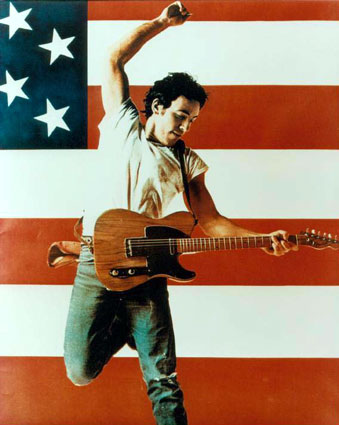
Bruce Springsteen Biography Coming

Peter Ames Carlin, it's been recently noted, has quit his job at the Oregonian newspaper to dedicate himself to writing a Bruce Springsteen biography.
Here he is singing the Steinbeck inspired, "The Ghost of Tom Joad":
Subscribe to:
Posts (Atom)