Showing posts with label Book Collecting. Show all posts
Monday, January 27, 2014
The Peculiar Underworld of Rare Book Thieves
Their world discussed on Paste.
From the piece...
Nearly as shocking was the barbarian behind it all: the library’s own director, Marino Massimo de Caro. A politically wired, self-taught book expert, De Caro and his cronies—allegedly including a lawyer and a priest—looted the library and destroyed its card catalogue to cover their tracks. De Caro even commissioned master forgeries of an ancient book by Galileo so he could swap them for the real thing at other libraries.
In the peculiar underworld of rare-book theft, De Caro joins a rogue’s gallery that features flamboyant eccentrics, disgruntled employees, corrupt academics—even a serial killer.
While the criminal personalities vary, according to the elite detectives who hunt book thieves, they all share something in common: base greed and a knack for gaining insider access to the cozy, exclusive world of rare-book collecting.
Monday, October 28, 2013
Monday, September 30, 2013
Monday, August 12, 2013
8.5 Tons of Comic Books
The Daily Mail visits the world's largest private comic book collection.
From the piece...
'My wife has always been supportive, she doesn't read comics, but helps me catalogue and maintain the collection.
'My kids, nieces and nephews, and their friends generally think the collection is pretty cool. The majority of my personal friends are also into reading and collecting.
'I have them racked so they don't need to be moved around much. If I need to get a comic I go to my database, see what box the comic is in, go to that box in the storage rack and pull a single box to get the comic I want.'
Still collecting, Bob reads around 115 comics a month - new and old.
Tuesday, August 06, 2013
Thursday, July 11, 2013
How to Invest in Rare Books
NuWireInvestor has some thoughts.
From the piece...
Yet do it right and rare books, like most collectibles, can provide a valuable option for hedging against losses in more mainstream investments.
As well as offering 9% pa returns over 20 years, books come with relatively low volatility (a standard deviation of less than 5%), according to Emotional Asset Research & Management.
“An investment portfolio that includes rare books is better positioned to withstand market cycles and provide long-term growth that extends well beyond retirement day. Rare books have historically proven to hold and appreciate in value in the long run,” Andre Chevalier of Rare Books Digest told Wealth Daily.
Yet, according to some speculators, volatility isn’t such a big deal in the investing world anymore; The VIX Index, a respected indicator of volatility, has declined from the mid-30s in fourth quarter 2011 to just 13 in May 2013.
Wednesday, June 12, 2013
Tuesday, May 28, 2013
Illuminated Manuscripts
They certainly are beautiful.
From a post on AbeBooks...
An illuminated manuscript is any manuscript whose text is accompanied by decoration. It originally referred only to silver or gilt adornments, but came to be acceptable terminology for any manuscript with drawings, paintings or decorations such as ornate initials, borders, floral accoutrements and the like. Often the illuminations would depict a historical or rural/pastoral scene.
The earliest confirmed example of illuminated manuscripts in existence today originated some 2000+ years ago. While some of the oldest instances were on papyrus, a thick, papery substance produced from the pulped flesh of the Egyptian papyrus plant, most were made of parchment, a thin writing material made from the skin of an animal, usually calf, goat or sheep. The highest quality parchment, very smooth and fine, was called vellum.
Monday, May 27, 2013
Sunday, May 26, 2013
Sunday, May 12, 2013
Autographed Uncle Tom's Cabin Found
Found in a coal cellar.
From a story in the Scotsman...
The copy of Uncle Tom’s Cabin by Harriet Beecher Stowe, signed by the author, was authenticated after it was found in a vast cellar full of donations. The book, with a price tag of about £1,500, is expected to be one of the biggest draw at this year’s event in Edinburgh.
“This came up from the coal cellars that we keep the stuff in all year, and it came out of a box yesterday. We have got a true attribution. It’s a book that changed history,” said the American book expert Reid Zulager, who flies in annually to sort rare items from tens of thousands of books on offer at the Christian Aid book sale.
The book by the abolitionist writer, a Connecticut teacher, set out to depict the true nature of slavery in human terms. Its author was once greeted by US president Abraham Lincoln, it is claimed, as “the little woman who wrote the book that made this great war”.
Wednesday, May 08, 2013
Collecting Fore-Edge Paintings
ILAB gives a brief tutorial.
From the piece...
The Italian Renaissance is, as with many things, where it all really started (although medieval examples exist). Often quite simple, floral decorations, heraldic designs or motifs, these were generally painted directly onto the fore-edge rather than later ‘fanned’ edge, sometimes with a gold background. These were not uncommon in 15th and 16th century Italy. But the term is now largely used to refer to the British examples of this art. Disappearing pictures start to appear, as it were, on mid 17th century English bibles and common prayer books. By the latter part of the 17th century, very fine works were being produced.
However, the pinnacle of this art was in the late 18th century revival and popularisation of the art by the bookbinders and booksellers Edwards of Halifax. They produced exquisite paintings on the edges, as well as beautiful ‘Etruscan calf’ and painted vellum bindings. London Society was wowed by the beautiful volumes, and the Edwards And Sons shop in Pall Mall is mentioned by Fanny Burney (also known as Madame d'Arblay), the 18th century London socialite who wrote an extensive diary as well as various novels.
The practice of fore-edge painting became widespread, and continued through the 19th and into the 20th century. Demand has always outstripped supply, and this meant that decorating the fore-edge continues to this day.
Saturday, April 27, 2013
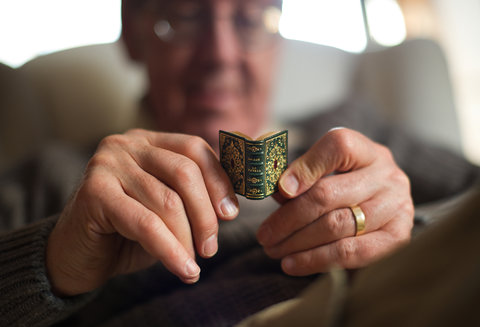
The World of Miniature Books
The New York Times explores the miniature book collection of Neale Albert.
From the story...
His book collection began in the early 1990s as an offshoot of his interest in meticulously detailed dollhouses. He had commissioned a model of Cliveden House in England, where he and his wife had spent a weekend. It required a library.
“What do you need for a library?” he said. “Books.”
So he started buying dollhouse-size books from collectors (partly with the assistance of a publication called International Doll House News). It took years to fill the dollhouse library, but by the time he’d finished, he was addicted.
Recently, Mr. Albert was showing me around the books in his rooftop cottage, when he made me an intriguing offer. “Let’s go downstairs,” he said. “I’ll show you the smallest book in the world.”
In his apartment, Mr. Albert showed me more books, including some with his favorite bindings: an atlas of the British Empire contained a goatskin-bound globe the size of a softball, and a book purporting to contain Voltaire writings held a key embedded in its cover to open the little book of erotica hidden inside. One miniature book was so small that its creator is said to have gone blind after setting its type.
On a bookshelf in the living room, Mr. Albert lifted a secret panel to retrieve what he said was the smallest book in the world.
Sunday, April 14, 2013
Thursday, February 28, 2013
The Weight of Books
David Ulin, for the Los Angeles Times, discusses the physical presence of books.
From the piece...
She’s right, my wife — the books are taking over the house, as they have taken over every house in which I’ve ever lived. Since childhood, I’ve been both reader and collector, not just defining but, in the most tangible sense imaginable, framing my world through books.
Yes, books are about the interior journey, the fluid back-and-forth between writer and reader, reader and writer, the interplay upon which literature depends. This is one of the best things about them, their insistence that we can only be enlarged, illuminated, by entering the imagination of another, which, in turn, inhabits ours.
And yet, there is another side of books, their physical presence: the sheer weight of all those volumes, the space they occupy. When I look at my books, arrayed from room to room now in their pleasing order, what I see are not just the ideas or narratives they represent but themselves as manifestations of my life.
Tuesday, February 26, 2013
Friday, February 15, 2013
World's Largest Collection of Authors on Vinyl Up for Sale
The National Post has a story about a man obsessed with collecting authors on records.
From the piece...
In some ways, it began with Dylan Thomas. In 1952, two young New Yorkers, Barbara Holdridge and Marianne Roney, heard him read at the 92nd Street Y. They were so impressed by the Welsh poet that they invited him to record his work the following day. Thomas only had enough material to fill one side of the record, so someone rushed out to get a copy of Harper’s Bazaar, which had printed one of his stories. “And that’s the only reason we have ‘A Child’s Christmas in Wales’ recorded,” says Gatenby. That was the first release by Caedmon Records and Dylan Thomas Reading, Volume 1 might be the first audiobook.
Gatenby’s collection is exhaustive, containing almost every major writer and literary figure of the 20th century: T.S. Eliot, William Faulkner, Ernest Hemingway, Gertrude Stein, Ayn Rand, J.R.R. Tolkien, Aldous Huxley, Vladimir Nabokov, Allen Ginsberg, Sylvia Plath, Rudyard Kipling, George Bernard Shaw, Ezra Pound, e.e. cummings, James Joyce, Robert Frost, Eudora Welty, E.M. Forster, John Steinbeck, Pablo Neruda, Dorothy Parker, Albert Camus, Mordecai Richler and Margaret Atwood. Gatenby owns Kurt Vonnegut reading Slaughterhouse-Five; Tennessee Williams reading from The Glass Menagerie, with a cover by Andy Warhol; Bertolt Brecht’s testimony before the Committee on Un-American Activity and Maya Angelou billed as “Miss Calypso.” Many have never been opened, most are in mint condition. “They didn’t get played over like The Beatles,” says Gatenby.
Friday, February 08, 2013
Collecting Gardening Literature
Horticultural books are ten-a-penny, but some could prove very valuable in the future, notes the Telegraph.
From the piece...
Park says: “If the term 'collectables’ has a suggestion of 'investment’ about
it then I feel that 20th-century books are now a very difficult area. So
much has changed in the past 20 years regarding the way texts and knowledge
are disseminated, and it is the more modern books which have suffered badly.
Most publishers now 'remainder’ their books – which means that hundreds, if
not thousands, of copies hit the shelves and the internet at a fraction of
their original price. Occasionally a book will sell out before this happens,
and if the publisher feels that a reprint is not justified then sometimes
second-hand demand outstrips supply and the price leaps.”
Park cites three volumes by fashionable Dutch garden designer Piet Oudolf:
Planting the Natural Garden, Designing With Plants and Planting Design, as
recent books that are worth holding onto – they’re now fetching £60 plus.
And he says books on other 20th-century designers are also collectable, as
is garden history: “Although styles go in and out of fashion, they still
influence what follows.”
Thursday, February 07, 2013
The Age of Innocence Found in a Rare Dust Jacket
Booktryst says it:
Take a good look; you'll likely never see another first edition copy of Edith Wharton's Pulitzer Prize-winning The Age of Innocence (1920) in its scarce first state dust jacket in this condition - ever again.
More from the piece...
It's usually lost along with the innocence of the age it illuminates, America in the 1870s and the Victorian social standards of contemporary New York high society.
When seen at all the first state dust jacket usually proclaims "Chips
Ahoy!" It's a rare cookie without divots aplenty at spine ends and along
the edges as if leaf-eating insects chomped a banquet.
First edition, first printing (with "1" on p. 365) copies without dust
jacket currently go for $2250-$9000. Copies in the first state dust
jacket cost considerably more. The copy under notice, for instance, is
being offered by Peter Harrington at $31,400 (£20,000). Prices are extremely sensitive to DJ condition.
Another copy in the first state dust jacket with a chunks missing at the
spine head and upper right corner sold for $23,500 not too long ago.
Saturday, January 19, 2013
Why Print Books Will Never Die
Some thoughts, care of Mashable.
From the piece...
But for people who truly love books, print is the only medium that will satisfy.
"People who need to possess the physical copy of a book, not merely an electronic version, believe that the objects themselves are sacred," he wrote.
"Some people may find this attitude baffling, arguing that books are merely objects that take up space. This is true, but so are Prague and your kids and the Sistine Chapel."
Subscribe to:
Posts (Atom)