Showing posts with label Antiquarian Books. Show all posts

Sunday, January 06, 2013

Banned Sex Manual Goes Under the Hammer


Aristotle's Compleat Master-Piece, which set out ideas on sexual relationships and pregnancy, first appeared around 1680.

From a story in the Guardian...

The book is thought to have served as a reference guide for amateur midwives and young married couples. It includes dire warnings about the possible consequences of extramarital sex.

"There's nothing in it that would really be considered dirty in our society now. It's funny more than anything," Marsden said. "There are various things which warn parents about what could happen to their children if they sinned whilst conceiving them, perhaps by having sex outside marriage. It would say that your baby would be born all hairy or it would suggest that conjoined twins were the result of the parents' sins.

"There are also interesting bits about the 17th century notion that it was considered beneficial for a woman to enjoy sexual intercourse in order to conceive. It suggests that both men and women should enjoy sex.

Thursday, December 20, 2012

Sunday, October 21, 2012

The World of Copper Engraved Plates


AbeBooks is our guide, here.

From the piece...

While steel was more durable, copper was softer and more easily engraved, allowing for an image richer in depth and tone. But as tools became more sophisticated, and the importance of mass production increased, durability became the main focus and steel became the popular choice. Known as copper engravings or copper-plate engravings, the pieces engraved on copper were produced with the use of a very hard steel tool called a burin, or graver, or later by machine, engraving the work into a flat plate. While this technique was satisfactory and pleasing for the creation of bold, clean linework, it was lacking in the area of shading and half-tones. 

These were accomplished through hatching, which consists of very thin lines, close together to give the appearance of shading or fill. For especially color-dense areas, those lines were engraved atop one another vertically and horizontally in a technique known as cross-hatching. Differently textured filled areas could also be accomplished by stippling, an engraving art technique similar to the painting technique of pointillism, involving the use of multiple tiny dots very close together for a dark, blanket effect, and further apart to denote lightening. 

Wednesday, October 17, 2012

The Oldest Quran in the World


A Yemeni man claims he's found it.

From a piece in Al Alabiya News...

The young man said that he found the holy book wrapped inside a leather cover by climbing down a rope to a mountain cave south of the Yemeni city of Dhale.

Initial tests on the authenticity of the manuscript have proven the Quran copy a genuine, marking the copy as the oldest in the world today.


Words that read: “This manuscript was handwritten in 200 hijri year (815 AD)” are engraved on the first page of the manuscript, according to the report.

Sunday, September 16, 2012

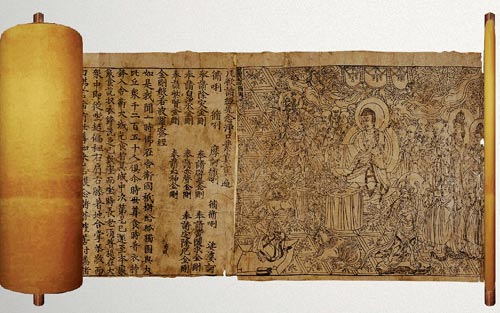
The Extraordinary Discovery Of The World's Oldest Book


Behold, Buddhism's Diamond Sutra.

From a piece in the Huffington Post...

Ask people to name the world's oldest printed book and the common reply is Gutenberg's Bible. Few venture that the answer is a revered Buddhist text called the Diamond Sutra, printed in 868 A.D. Or that by the time Gutenberg got ink on his fingers nearly 600 years later -- and his revolutionary technology helped usher in the Enlightenment -- this copy of the Diamond Sutra had been hidden for several centuries in a sacred cave on the edge of the Gobi Desert and would remain there for several more.

Its discovery is the result of a series of accidents and its significance realized belatedly. The book unwittingly came to light when a Chinese monk clearing sand from a Buddhist meditation cave in 1900 noticed a crack in a wall. It suggested the outline of a doorway. Plastered over and painted, the entrance had been deliberately concealed.

The monk, Abbot Wang Yuanlu, broke in and discovered a small chamber, about nine feet square and full from floor to ceiling with scrolls. They had been hidden and perfectly preserved in the dark, dry grotto for 1,000 years. Although he didn't know it, among the nearly 60,000 scrolls was the Diamond Sutra of 868 A.D., a woodblock printed scroll, more than 16 feet long, complete and dated, with an instruction that it be given away for free.

Antiquarian Hats


Yes, hats. Lots of hats.

Friday, September 14, 2012

De Hortus Sanitatis


A rare 500-year-old medical text is being displayed at the University of Aberdeen.

From a piece in the Daily Mail...

The De Hortus Sanitatis, which translates as the Garden of Health, shows some of the medical methods practiced in Scotland five centuries ago and is one of the earliest European medical texts.
 
The book, first printed in Mainz, Germany, in 1491, is a fusion of late medieval science and folklore. 

It contains detailed writings and annotated illustrations on plants, herbs, animals, and minerals.

Meanwhile, detailed illustrations reveal how physicians used to study the colour of urine to make diagnoses.

Thursday, September 06, 2012

Rare Beekeeping Books Go On Display


Having always wanted to be a bee keeper (or, at least, try out one of those weird bee beards), I think it'd be pretty great to see a display of rare beekeeping books on display in Scotland.

From a piece on Abe Books...

The books come from the Moir Rare Book Collection – one of the finest collections of rare beekeeping books in the world and the display will celebrate the centenary of the Scottish Beekeepers’ Association.

The Moir Rare Book Collection consists of 250 volumes and includes works dating back to 1525. John William Moir (1851-1940) began beekeeping while in Africa before returning to his native Scotland. He became one of the original members and first vice-chairman of the council of the Scottish Beekeepers’ Association, and started to collect bee literature.

Beekeeping terminology is lovely. If you visit the NLS, you will see literature illustrating the piping and quacking of queen bees, the coaxing of a swarm into a skep, and also the medicinal benefit of honey.

My family kept bees during my childhood but I always regarded the hive with some caution and watched from a distance when the bees were being tended to.  The honey was exceptional.

Saturday, August 25, 2012

The Difficulty of Insider Book Theft


Oxford University Press takes a look at the black market rare book trade.

From the post...

He seems to have treated the place as his own personal collection, stealing and selling hundreds — maybe thousands — of rare and antiquarian books during his 11 month tenure. This has provoked the normal amount of head-shaking and hand-wringing. But what is most striking — aside from the embarrassing appointment of the unqualified de Caro to the job in the first place — is how terrible a thief he was.

For an insider, stealing rare books, maps and documents is easy. It takes no talent and very little planning. But turning those stolen items into cash while also staying out of jail requires skill, and a great deal of effort. De Caro, like many insiders before him, seems not to have properly thought this through.

The first step in the successful insider heist is to identify items unlikely to be either missed by the institution or recognized by buyers as stolen. For the same reason that stealing the Mona Lisa is a bad idea, taking the most famous or in-demand items in a library or archive is ill-advised. They’ll be likely recognized as missing and, in any event, will raise suspicions in anyone knowledgeable enough to pay full price for them.

Sunday, August 12, 2012

Together, As Always


A photography project by Julianne Aguilar, Together, As Always, highlights inscriptions in used books.

Enjoy!

Friday, August 10, 2012

The E-Reader Generation is Falling in Love with Antiquarian Books


So says the Denver Post.

From the piece...


Collectors in their 20s, she said, "get all excited about something old that connects them to the past."

Tess Hamilton, 17, was introduced to antiquarian books about 10 years ago, when her mother often took her and her brother to The Hermitage Bookshop. She started with "Wind in the Willows" and "Winnie the Pooh" but has graduated to collecting first editions of Raymond Carver.

"Almost everyone I know has e-books," she said. "They're more convenient, lighter and easier to carry around. But there's something about the weight of a book, and smelling it. It's not the same reading it on a little screen."


Tuesday, August 07, 2012

The Erotic Pop-Up Book from 1846


Booktryst reveals it, here.

From the post...

It is
Variations de l'Amore, a suite of nine numbered, gilt-bordered watercolors, image size 115 x 160 mm,  with overlaid slips that was clandestinely issued c. 1846 (that date appearing on one of the plates), likely in Germany, with captions in German and French.

It is not the earliest work of erotica in movable book format, innocent scenes whose overlays, when lifted, reveal graphic sexual situations. I have seen two other erotic movable books with overlays,
Moeurs de Paris 2eme Livraison, with illustrations by, amongst others, Achille Deveria, published c. 1835 in London (i.e. Paris), and Les Portes et FenĂȘtres, paru en livraisons (Paris, 1835) with plates by Henri Monnier, DevĂ©ria, etc., its "doors and windows" providing an eyeful when opened.