Showing posts with label Religious Texts. Show all posts
Tuesday, July 22, 2014
Friday, October 11, 2013
The World's Oldest Jewish Prayer Book?
It has 50 pages of Jewish blessings and has been dated back to 840 C.E.
From a piece in the Daily Mail...
'This Hebrew prayer book helps fill the gap between the Dead Sea Scrolls and other discoveries of Jewish texts from the ninth and 10th centuries.'
The
complete parchment is in its
original binding and contains Hebrew script so archaic that its founders
claim it 'incorporates Babylonian vowel pointing' - is similar to Old
or Middle English when compared to the current English language.
Tuesday, September 24, 2013
Sunday, June 02, 2013
World's Oldest Torah Scroll Found
It comes from the 12th or 13th century.
From a piece in Christianity in Antiquity...
The University Library of Bologna has kept from times immemorial, and without knowing, the world’s oldest scroll of the Hebrew Pentateuch. The document, labeled as “Roll 2″, is of soft sheep leather (36 meters long and 64 cm high), comprises the full text of the Torah (i.e. Genesis, Exodus, Leviticus, Numbers and Deuteronomy) and had previously been cataloged a 17th–century scroll. Instead, “Roll 2″, was copied in a period between the second half of the 12th and the early 13th century (1155-1225) and is therefore the most ancient complete Hebrew scroll of the Torah known today: a copy of immense value, the importance of which is evident to scholars and a non-specialist-audience alike.
Monday, May 27, 2013
Thursday, May 02, 2013
550-Year-Old Jewish Holy Book Goes to Auction
It's the Mishneh Torah.
From a piece in the Independent...
And Mr Steinhardt, 72, said: “We could not be happier that this rare and remarkable manuscript will be in the care of the Israel Museum and The Metropolitan Museum of Art in perpetuity.
"One of the world’s most significant Hebrew manuscripts, the Mishneh Torah will add important new dimensions to both collections - and its shared homes in New York and Jerusalem will ensure the broadest public engagement with the work. Judy and I are also delighted for our role within the group of donors who are making this key acquisition possible.”
The 385 other lots cover seven centuries of Jewish culture and come from around the world. Many items are estimated at less than $10,000.
Sunday, April 21, 2013
How the American Novel Lost Its Religion
American fiction was once inseparable from
proselytizing. How did it become the anticlerical, ego-theistic
literature of today? Cultural historian Philip F. Gura looks at the evolution.
From a piece in the Daily Beast...
The early 19th century was characterized by major transformations of traditional patterns of belief. In 1800 the overwhelming majority of Americans defined themselves as subjects of a distant, all-powerful God. A quarter century later, as the secular, republican beliefs of the revolutionary generation took deeper root, religious belief moved hesitantly and not without conflict toward the idea of free will. Then, in the two decades prior to the Civil War, there occurred a momentous shift from free will to self-consciousness. As Emerson put it, “the mind became aware of itself.” To him, to like-minded contemporaries, and to many if not most Americans since, the once-accepted notion that a person should spend his time on earth building his Christian character was obsolete. Instead, each American should spend his days cultivating his individualism, his selfhood.
Wednesday, April 17, 2013
It Will Be the Most Expensive Book Ever Sold
It's the Bay Psalm Book and it will be going to auction in November expected to get as much as $30 million.
From a piece on ABC News...
The Bay Psalm Book, which is the first book printed in what is now the United States, comes from the Old South Church in Boston, one of two copies of the book in its collection.
“One copy, the copy we are keeping, was bequeathed to us by our fifth minister, the Reverend Thomas Prince,” Nancy Taylor, Old South Church’s senior minister and CEO, told ABCNews.com.
Sotheby’s specialists used comparables to value the book. “We have sold books as much as $11.5 million in the past, which are far less rare than this,” Redden said. The last Bay Psalm Book was bought at a Sotheby’s auction in 1947 for $151,000 by Yale University.
Thursday, December 27, 2012
Jesus Lit
Besides the Gospels, what’s the best literary treatment
of the life of the Messiah? David Masciotra, for the Daily Beast, looks at the many efforts,
from Anne Rice to Norman Mailer.
In addition to inspiring an entire
religion, Jesus also inspired many works of fiction. Some are loyal to
the account of Jesus’s life told in the Synoptic Gospels, and some take
poetic, dramatic, and speculative license. The Jesus novel is a small
and largely unrecognized genre of literature that often gives Christians
new insight into the story of their savior, and provides non-believers
with an artistic means of accessing a tale containing all of the most
effective tools of drama—pity, terror, sadness, heroism, tragedy, and
redemption.
Thursday, December 20, 2012
The Dead Sea Scrolls....Digitally?
Indeed.
From a brief piece in the New York Times...
The digitization project, the result of two years of scanning using technology developed by NASA, allows users to zoom in on details of the often highly fragmentary scrolls, which contain versions of every book of the Hebrew Bible (except the Book of Esther), including one of the oldest known copies of Genesis and a copy of Psalms containing one of the oldest known references to King David.
The scrolls, believed to have been written or collected by an ascetic Jewish sect that settled in the desert at Qumran in the Judean desert after fleeing Jerusalem sometime around the second and first centuries B.C., also include a number of non-biblical books that provide insight into the origins of Christianity. Five scrolls were previously digitized, and posted online by the Israel Museum last year.
Wednesday, December 05, 2012
Sunday, December 02, 2012
Why Smug Athiests Should Read More Science Fiction
io9 lays it out.
From the piece...
A lot of the best science fiction includes a sense of wonder at the hugeness of the cosmos — and the flipside of that is a sense of our own smallness. And the humility that goes along with that. If you want to feel a real sense of quasi-religious awe, don't think of the world as being 6,000 years old — think of its actual age, measured in billions of years, and the huge timescales of the universe before and after our world. And think of the vastness of the cosmos, whose mysteries we've only just begun to glimpse in the past century.
A lot of the best science fiction is intensely "cosmic," conveying just how huge and unknowable the universe is, and how little we still understand it. In a sense, the huge cosmic imagery of science fiction resembles some of the best religious paintings — like the artworks of William Turner, who depicts light bursting out of the frame in a way that's often almost too dazzling to take in. Or Pieter Bruegel the Elder, whose angels are like explosions of light and energy. Contemplating space and time in all of their massive strangeness is much like gazing into the naked face of God is supposed to be — apt to drive you mad, or at the very least to make you recognize how tiny and ignorant you are.
Wednesday, November 07, 2012
Who Wrote the Book of Mormon?
That's the question posed by the Los Angeles Review of Books.
From the piece...
WHO WROTE THE BOOK OF MORMON? For nearly two centuries, faithful members of The Church of Jesus Christ of Latter-Day Saints (LDS) have claimed that Joseph Smith translated the text from the writings of ancient prophets, while critics have endlessly recycled inadequate theories of plagiarism or co-authorship. What has rarely been addressed is that for much of his language and narrative structure, Smith turned to the most read and memorized author of the late seventeenth century, John Bunyan. He did so in such imaginative ways that the resulting work transcends any easy charge of plagiarism and calls upon us to reimagine the rich oral traditions of early America.
Parallels between Bunyan’s The Pilgrim's Progress (1678) and the Book of Mormon have not gone entirely unnoticed. As early as 1831, Eber Howe, in his anti-Mormon book Mormonism Unvailed, noted the use of names — “Desolation” and “Bountiful” from Pilgrim’s Progress reappear in the Book of Mormon — but most observations have been similarly limited in scope or suffered from lack of a systematic methodology. Bunyan wrote upwards of 60 books, tracts, and pamphlets, including Grace Abounding, A Few Sighs from Hell, Holy War and The Life and Death of Mr. Badman, and these texts provide extensive narrative parallels to the Book of Mormon, often containing unique characteristics shared only by Bunyan and Smith.
For decades, LDS Church leaders have worked to mainstream the LDS faith, and with the nation on the verge of potentially electing the first Mormon president, coupled with the rising influence of the church in the cultural and political landscape of America, some have dubbed this period the “Mormon Moment.”
Thursday, October 25, 2012
The Book of Common Prayer at 350
James Wood discusses its importance in the New Yorker.
From the article...
The visitor has stumbled upon a service, Evensong, whose roots stretch back at least to the tenth century, and whose liturgy has been in almost continuous use since 1549, the date of the first Book of Common Prayer, which was revised in 1552, and lightly amended in 1662, three hundred and fifty years ago. The Book of Common Prayer was the first compendium of worship in English. The words—many of them, at least—were written by Thomas Cranmer, the Archbishop of Canterbury between 1533 and 1556. Cranmer did not cut his text from whole cloth: in the ecumenical spirit that characterizes the Book of Common Prayer, he went to the Latin liturgy that the English Catholic Church had used for centuries. In particular, he turned to a book known as the Sarum Missal, which priests at Salisbury Cathedral had long used to conduct services. It contained a calendar of festivals, along with prayers and readings for those festivals; and it held orders of service for Morning Prayer, Evening Prayer, and the Mass.
The Missal was a handbook for priests and monks, though, not for the laity, and its language was Latin, not English. Cranmer wanted a prayer book in English, one that could be understood by ordinary people, even by those who could not read. To this end, he translated and simplified a good deal of the Sarum Missal: from the monastic services of Matins, Vespers, and Compline he fashioned Morning Prayer and Evening Prayer (commonly known now as Evensong), which are familiar to millions of members of the worldwide Anglican Church. He borrowed elements of the liturgy of the Reformed church in Cologne, and adapted a prayer of St. John Chrysostom from the Byzantine rite. He also wrote dozens of new prayers and collects, in a language at once grand and simple, heightened and practical, archaic and timeless.
Wednesday, October 17, 2012
The Oldest Quran in the World
A Yemeni man claims he's found it.
From a piece in Al Alabiya News...
The young man said that he found the holy book wrapped inside a leather cover by climbing down a rope to a mountain cave south of the Yemeni city of Dhale.
Initial tests on the authenticity of the manuscript have proven the Quran copy a genuine, marking the copy as the oldest in the world today.
Words that read: “This manuscript was handwritten in 200 hijri year (815 AD)” are engraved on the first page of the manuscript, according to the report.
Sunday, October 07, 2012
Shakespeare as God
The Millions offers a piece on reading Shakespeare and how it's nearly a religious experience.
From the Stephen Akey essay...
Another curiosity about the romances is the degree to which they turn on the concept of forgiveness. “Pardon’s the word to all,” says Cymbeline late in the play of that title, jauntily brushing aside five acts worth of treachery, corruption, murder, and deceit. Was there something in Shakespeare’s experience that turned his thoughts in his last years to the possibility of forgiveness? Had his many years as an absent husband and father begun to gnaw at him as he contemplated retirement and a return to the wife and family he had clearly neglected? Or had his wife Anne – perhaps understandably in the light of their long separation – been “sluiced” in his absence, and had he, with all his attendant guilts and slippages, to pardon her for that? Was he thinking of the Catholicism he might secretly have been raised in and of the doctrine of grace that – it could be argued – subtly informs these plays? Or was it something simpler and even more personal – namely, brooding on the usual fuckups that everyone racks up over time and hopes to be forgiven for? Virtually nothing is known of the man’s inner life, but few people dispute the semi-autobiographical nature of The Tempest, with its sense of a valediction to the theater he had known and loved. So why not extrapolate a little from the work to the life?
Depends on whose life, I guess. While I’m very much interested in Shakespeare’s life, I’m more interested in my own. What I extrapolate from The Winter’s Tale is that if Leontes deserves a break, so do I. There came a time in my life when I needed to be forgiven. I wasn’t. If I must take my consolation from a play rather than from any flesh and blood Hermione, that’s not quite so bleak as it sounds. Yes, I would have preferred real forgiveness to the literary kind, but I find it no small consolation that at the end of his life the world’s supreme imaginative writer returns again and again to a basic home truth: we must forgive each other. For me, reading Shakespeare is like going to church, except that in place of a God I could never and wouldn’t want to believe in, I “commune,” so to speak, with a mind that seems to comprehend all others and enforces no doctrinal obedience. This community of believers embraces anyone who has ever seen, heard, or read a word of Shakespeare’s and been moved to wonder and reflection. That’s what I call a catholic church.
Sunday, September 16, 2012
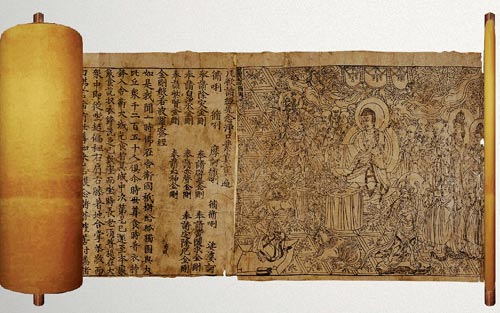
The Extraordinary Discovery Of The World's Oldest Book
Behold, Buddhism's Diamond Sutra.
From a piece in the Huffington Post...
Ask people to name the world's oldest printed book and the common reply is Gutenberg's Bible. Few venture that the answer is a revered Buddhist text called the Diamond Sutra, printed in 868 A.D. Or that by the time Gutenberg got ink on his fingers nearly 600 years later -- and his revolutionary technology helped usher in the Enlightenment -- this copy of the Diamond Sutra had been hidden for several centuries in a sacred cave on the edge of the Gobi Desert and would remain there for several more.
Its discovery is the result of a series of accidents and its significance realized belatedly. The book unwittingly came to light when a Chinese monk clearing sand from a Buddhist meditation cave in 1900 noticed a crack in a wall. It suggested the outline of a doorway. Plastered over and painted, the entrance had been deliberately concealed.
The monk, Abbot Wang Yuanlu, broke in and discovered a small chamber, about nine feet square and full from floor to ceiling with scrolls. They had been hidden and perfectly preserved in the dark, dry grotto for 1,000 years. Although he didn't know it, among the nearly 60,000 scrolls was the Diamond Sutra of 868 A.D., a woodblock printed scroll, more than 16 feet long, complete and dated, with an instruction that it be given away for free.
Monday, September 03, 2012
Greatest Superheroes Based On Their Religious Faith
The greatest Methodist superhero? Superman.
The greatest Jewish superhero? The Thing.
Comic Book Religion offers up others, here.
From the piece...
Greatest Mormon Superhero: Captain Canuck
When it comes to religion, Latter-day Saints (or "Mormons") outnumber Jews in the United States (according to the 2007 survey of 35,000 people by the Pew Forum on Religion and Public Life, based in Washington, D.C.). Yet there have been literally hundreds of Jewish super-heroes in published comics, but only a handful of Latter-day Saints - even fewer if one considers only super-heroes overtly identified by name as Latter-day Saints.
From this relative paucity, we have selected Tom Evans (the Canadian counterpart to Captain America) as the greatest Latter-day Saint superhero. Captain Canuck is a relatively prominent super-hero (at least compared to other Latter-day Saint superheroes). Captain Canuck was genuinely written as a Latter-day Saint by his creator and principle chronicler. Plus, he always displayed devotion to his beliefs and a strong moral center that Latter-day Saint readers can be proud of.
Captain Canuck is not as well known as some mainstays of Marvel and DC comics (a la Superman, Batman, Spider-Man, et al), but he is universally known among Canadian comic book fans. Captain Canuck was even honored on a Canadian postage stamp. Captain Canuck easily ranks in the top 2 or 3 most famous Canadian superheroes of all time, and he is well known and respected among comic book fans with interests in classic independent (non-Marvel/non-DC) superhero characters. But one knock against Captain Canuck's "greatest" status is the fact that he is NOT part of the two best known comic book universes: Marvel and DC.
Another problem with Captain Canuck is the fact that it isn't clear that he was ever overtly identified by name as a Latter-day Saint in published comics. Captain Canuck was the creation of a devout Latter-day Saint comic book writer - Richard Comely. Captain Canuck says Latter-day Saint-style prayers in published comics and does and says a number of things which clearly hint at his religious affiliation. Among careful readers, there is no real question about what Captain Canuck's religion is and that he was a sincere, devout member, but because it wasn't mentioned by name, this fact is unknown by many.
But Captain Canuck is a Latter-day Saint and, moreover, he is a truly great super-hero. He represented Canada before there was Alpha Flight or other modern Canadian national heroes and he embodied Canadian ideals and philosophies more than most super-heroes who just happen to be Canadian. (Wolverine, for example, hardly represents Canadian values and ideals). Canadians, tolerant by nature, never seemed to mind that they were represented in superherodom by a member of a denomination that may be very prominent in Alberta but is a small minority in most of their nation.
Sunday, July 15, 2012
Sunday, June 10, 2012
The Gospel of Stephen King
CNN takes a look at the spiritual side of the most famous horror writer alive.
From the piece...
Want to read a powerful meditation on Jesus’ sacrificial love? Check out how King links the death of the mammoth death row inmate John Coffey (note the initials, J.C.) to Jesus’ crucifixion in “The Green Mile.” King’s “Storm of the Century” is a creepy retelling of Jesus’ eerie encounter with the demon called “Legion” in the Gospel of Mark’s fifth chapter. And King’s epic apocalyptic novel, “The Stand,” reads like a contemporary retelling of the Book of Revelation, with a little Exodus thrown in, Zahl says.
Zahl’s claim about King's faith may sound ludicrous. King, who just released his latest novel, “The Wind Through the Keyhole,” has written at least 50 horror novels such as “Carrie” and “Misery.”
Yet there is an actual body of literature devoted to King’s religious sensibility. Several pastors and authors say King displays a sophisticated grasp of theology in his books, and his stories are stuffed with biblical references and story lines taken straight from the Bible.
Subscribe to:
Posts (Atom)