Showing posts with label Illustration. Show all posts
Friday, June 27, 2014
Monday, December 09, 2013
Tuesday, September 03, 2013
Tuesday, August 27, 2013
Sunday, April 21, 2013
How To Make a Picture Book
Adam Rex discusses the process he used to create a picture book based on Neil Gaiman's text.
From the piece...
I draw 32 or 40 or whatever little boxes on a single page of my sketchbook and start filling them in. I only have the most rudimentary notion what each page is going to look like, but this is where I usually discover the ideas that will make this my book as opposed to a book that was merely illustrated by me.
Once I have all my pandas in a row I probably sketch character designs. This is easily my favorite part of the process, when everything's still new and the book in question is still the best thing I've ever done or will do.
Sunday, March 31, 2013
Wednesday, March 06, 2013
Thursday, February 28, 2013
Saturday, February 16, 2013
Wednesday, February 13, 2013
Friday, February 01, 2013
How Do I Become...An Illustrator
Technique, self-belief and a targeted approach are all vital to achieving success, says Harry Potter illustrator Cliff Wright – but a degree is less important.
From a story in the Guardian...
The most important quality for an aspiring illustrator is, he reckons, self-belief. "Most people get told at some point that they're no good, and publishers can be challenging to work with," he says. "The key is to use criticism to develop your ideas but not to take it personally."
A degree from an art college is less important than a strong, focused portfolio, he believes. "Drawing skills aren't taught at art college these days," he says. "I taught myself about watercolouring from DIY books – a few terms at a drawing workshop after work could be just as formative as a degree."
Also important is to target overtures to companies who are relevant to a portfolio rather than a random blitz of a business directory.
Monday, January 28, 2013
Tuesday, November 27, 2012
Sunday, November 18, 2012
Tuesday, November 13, 2012
Authentic 'Alice Through the Looking Glass' Chess Board Discovered
An 'Alice Through the Looking Glass' chess board, hand-crafted in 1875 by the 'Alice novels' illustrator Sir John Tenniel, has been discovered and 150 limited-edition replicas made.
From a piece in the Telegraph...
Now it seems Tenniel (1820-1914) may have considered a sideline in creating Alice
merchandise.
In summer 2011, an Alice-themed chess board was bought by rare books
dealer Jake Fior, who, upon closer inspection, discovered that it had been
illustrated by Tenniel himself and was one-of-a-kind.
The board features 16 ink and watercolour illustrations of images from the
novel Alice Through the Looking Glass along its gilded border. It is
believed to have been created in 1875 – four years after the book’s
publication.
Sunday, November 04, 2012
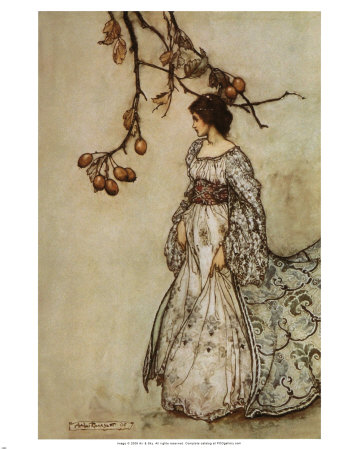
The Magic Illustrations of Arthur Rakham
AbeBooks celebrates the noted illustrator, here.
From the piece...
Much of Rackham's work depicts gnomes, fairies, goblins or other creatures from mythology, folklore or fable. His work has been an inspiration to many, including film director Guillermo del Toro (Pan's Labyrinth) and modern illustrator Brian Froud. Beyond the fantastical natural world, Rackham also found inspiration in unusual places, creating his own artistic interpretations of pieces from music and theater, such as Wagner's operas, or Shakespeare plays.
Whether illustrating whimsical books for children or darker matter for adults, Rackham's imaginative, brilliant illustration style was highly sought after and enhanced any text it accompanied. Rackham died in 1939, and now, more than 70 years after his death, his work is collectable and beloved. Children and adults alike take pleasure in the unique, beautiful art he provided for some of the world's greatest stories.
Wednesday, October 31, 2012
The Return of Edward Gorey
Edward Gorey's arch eccentrics are on display in two reissues and a never-before-published story.
From a story in the Los Angeles Times...
Twelve years after his death on tax day 2000, Edward Gorey — writer, illustrator, Victorian aesthete born half a century too late — has earned an adjective all his own: "Goreyesque."
The word is used, increasingly, to refer to anything that manages to be amusingly lugubrious, in an arch sort of way. In recent years, Gorey's eccentric shadow has only lengthened across pop culture, his influence apparent in Tim Burton's gothic whimsies; the Lemony Snicket books by Daniel Handler; the emergence of the Gorey tattoo as a hipster fad; crowds thronging to the traveling exhibition of his work, "Elegant Enigmas"; and the resurrection of out-of-print Gorey tales
Three Gorey titles have just landed on bookstore shelves.
From Pomegranate Press comes "Thoughtful Alphabets: The Just Dessert & the Deadly Blotter" (64 pp., $14.95), previously published only in obscure, limited editions, and "The Osbick Bird" (32 pp., $12.95), a Gorey classic unavailable for four decades, except in poor quality in "Gorey's Amphigorey Too" anthology, but now restored to a clarity so sharp-nibbed it almost hurts the eye.
Bloomsbury is also in on the act with "Saint Melissa the Mottled" (48 pp., $12), an unpublished story that Gorey never got around to illustrating, supplemented here with images from the Gorey archive, some never before published.
Thursday, October 25, 2012
Tuesday, October 23, 2012
Young Henry VIII Revealed
A long lost "royal treasure" with one of the earliest paintings of Henry VIII has been discovered at the National Library of Wales.
From a piece on BBC News...
The manuscript was donated to the Aberystwyth library in 1921, but officials say they have only just realised its true significance.
One of its 34 pictures is believed to show 11-year-old Henry weeping at the empty bed of his mother, Elizabeth.
The library said the manuscript could be worth more than £1m.
Bound in wooden boards and
covered with crimson velvet, the manuscript contains a late 15th Century
passional - a book recounting the sufferings of saints and martyrs -
depicting Jesus Christ's last days on earth through a series of images
and text, written in medieval French.
It also has the poem Le Miroir de la Mort (The Mirror of Death) by Georges Chastellain.
It is believed the manuscript was presented to Henry VII, Henry's father, after the death of his wife Elizabeth of York.
Sunday, October 21, 2012
The World of Copper Engraved Plates
AbeBooks is our guide, here.
From the piece...
While steel was more durable, copper was softer and more easily engraved, allowing for an image richer in depth and tone. But as tools became more sophisticated, and the importance of mass production increased, durability became the main focus and steel became the popular choice. Known as copper engravings or copper-plate engravings, the pieces engraved on copper were produced with the use of a very hard steel tool called a burin, or graver, or later by machine, engraving the work into a flat plate. While this technique was satisfactory and pleasing for the creation of bold, clean linework, it was lacking in the area of shading and half-tones.
These were accomplished through hatching, which consists of very thin lines, close together to give the appearance of shading or fill. For especially color-dense areas, those lines were engraved atop one another vertically and horizontally in a technique known as cross-hatching. Differently textured filled areas could also be accomplished by stippling, an engraving art technique similar to the painting technique of pointillism, involving the use of multiple tiny dots very close together for a dark, blanket effect, and further apart to denote lightening.
Subscribe to:
Posts (Atom)