Wednesday, September 19, 2012

New Novel from Harlem Renaissance Found


A manuscript by Claude McKay has been found.

From a story in the New York Times...

“This is a major discovery,” said Henry Louis Gates Jr., the Harvard University scholar, who was one of three experts called upon to examine the novel and supporting research. “It dramatically expands the canon of novels written by Harlem Renaissance writers and, obviously, novels by Claude McKay. 

“More important, because it was written in the second half of the Harlem Renaissance, it shows that the renaissance continued to be vibrant and creative and turned its focus to international issues — in this case the tensions between Communists, on the one hand, and black nationalists, on the other, for the hearts and minds of black Americans,” said Mr. Gates, the director of the W. E. B. Du Bois Institute for African and African American Research at Harvard. 

This literary detective story began in the summer of 2009, when Jean-Christophe Cloutier, a doctoral candidate in English and comparative literature, was working as an intern in the Rare Book and Manuscript Library at Columbia.

Tuesday, September 18, 2012

The Book Covers of On the Road


Enjoy!

5 Dessert Cookbook Classics


The list, care of Hazlitt.

Play It Again, and Again


The trade in music manuscripts is usually tranquil, but many specimens of inestimable value are going under the hammer.

From an article in the Financial Times...

Every so often the usually tranquil trade in music manuscripts is rocked by a remarkable event, and the sale of the André Meyer collection in Paris on October 16-17 will be one such. In Dr Roe’s view, this is the most important private collection of musical manuscripts and early printed scores in Europe. It was compiled as a labour of love by the Paris-based textile magnate André Meyer (1884-1974), who generously opened it to researchers; Rostropovich worked there on Debussy’s early albums, and it was there that Stravinsky joyfully rediscovered one of his manuscripts for The Rite of Spring. Since Meyer’s death it has been locked from view.

Among the treasures now going under the hammer is the libretto for Monteverdi’s lost opera Ariana, the first collected edition of Bach’s keyboard partitas, a first edition of Rameau’s Traité de l’Harmonie with the composer’s annotations, and a signed autograph manuscript of Schoenberg’s Opus 10 string quartet. And something to set the pulse racing: an unpublished page of piano exercises by Beethoven, with a sketch for a major composition – which neither Roe nor anyone else can identify – on the reverse. It was bought by a collector after Beethoven’s death, then presented as a gift to Chopin when he visited Vienna in 1830: it may comfortably exceed its estimate of €100,000- €150,000.

To scholars, an untampered-with manuscript is of inestimable value, being a unique indicator of a composer’s intentions. This is why the dismemberment (for commercial reasons) of Beethoven’s sketchbooks after his death was such a disaster, and why Roe and his colleagues are so opposed to the well-meaning but misguided “restorations” which some of the biggest libraries have carried out.


Jon Contino

Jon Contino from Kevin Steen on Vimeo.

10 Great War Books Written by Women


The list, care of Flavorwire.

Monday, September 17, 2012

It Was Written - Books By Rappers


N+1 takes a look at the recent proliferation of rapper memoirs.

From the piece...

The last few years have been good for hip hop nerds, bringing along with the usual mixtapes and albums an unexpected load of books. It began with Jay-Z’s deluxe coffee-table memoir Decoded. Then there was My Infamous Life by Albert Johnson, otherwise known as Prodigy of Mobb Deep, and an autobiography by Common. Ice-T has added to the pile, and Fifty Cent has released a young adult story about bullying. (He’s against it.) Nas is apparently at work on something, as well as Lil Wayne, Cee-Lo, and Q-Tip of A Tribe Called Quest. It may seem predictable that rappers would sooner or later capitalize on our memoir-happy times—can’t knock the hustle now—but the amount of ink being spilled suggests that more is at play.

Also relevant here is Yale’s The Anthology of Rap. For the unfamiliar, the book is just what it sounds like: a hefty collection of rap lyrics. It’s the first of its kind, so it’s been enjoyable and salutary to see the literary world come to terms with it. Hip hop has long been written about, of course, but it’s not everyday you see it treated in the New York Review of Books, or hear people, Sam Lipsyte in this case, praising the “lush Keatsian soundplay” of Jay-Z. That said, responses to the book have been mixed. The editorial writing is informative and the contents are, for the most part, inclusive. There may be nothing by Redman, and The Pharcyde are relegated to the perfunctory “Lyrics for Further Study” section, but why quibble? After all, here’s Ultramagnetic MCs, Freestyle Fellowship, and Devin the Dude. The lyrics themselves, however, often so memorable in their natural  element, can look lifeless or painfully silly on the page. And though hip hop has been an object of academic study for years now, institutionalization seems to jar with its spirit.

Whatever you make of it, the anthology was going to happen, and is a sign that hip hop is reaching a place of wider legitimacy.


There's a Pencil Museum?


Yes. Pencil in a visit, will you?

Dungeons and Dragons: A Documentary

Dungeons & Dragons: A Documentary from Westpaw Films on Vimeo.

10 Books to Impress Any Music Snob


The list, care of Flavorwire.


Bad Children's Books


Brilliant.

Sunday, September 16, 2012

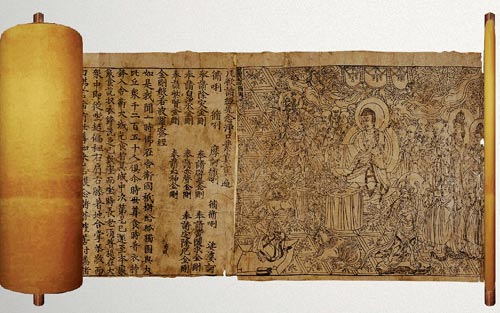
The Extraordinary Discovery Of The World's Oldest Book


Behold, Buddhism's Diamond Sutra.

From a piece in the Huffington Post...

Ask people to name the world's oldest printed book and the common reply is Gutenberg's Bible. Few venture that the answer is a revered Buddhist text called the Diamond Sutra, printed in 868 A.D. Or that by the time Gutenberg got ink on his fingers nearly 600 years later -- and his revolutionary technology helped usher in the Enlightenment -- this copy of the Diamond Sutra had been hidden for several centuries in a sacred cave on the edge of the Gobi Desert and would remain there for several more.

Its discovery is the result of a series of accidents and its significance realized belatedly. The book unwittingly came to light when a Chinese monk clearing sand from a Buddhist meditation cave in 1900 noticed a crack in a wall. It suggested the outline of a doorway. Plastered over and painted, the entrance had been deliberately concealed.

The monk, Abbot Wang Yuanlu, broke in and discovered a small chamber, about nine feet square and full from floor to ceiling with scrolls. They had been hidden and perfectly preserved in the dark, dry grotto for 1,000 years. Although he didn't know it, among the nearly 60,000 scrolls was the Diamond Sutra of 868 A.D., a woodblock printed scroll, more than 16 feet long, complete and dated, with an instruction that it be given away for free.

Antiquarian Hats


Yes, hats. Lots of hats.

Elektrobiblioteka

Elektrobiblioteka / Electrolibrary from waldek wegrzyn on Vimeo.

Your Brain on Jane Austen


Stanford researchers observe the brain patterns of literary PhD candidates while they're reading a Jane Austen novel. The fMRI images suggest that literary reading provides "a truly valuable exercise of people's brains."

From a story on Stanford University News...

In an innovative interdisciplinary study, neurobiological experts, radiologists and humanities scholars are working together to explore the relationship between reading, attention and distraction – by reading Jane Austen.

Surprising preliminary results reveal a dramatic and unexpected increase in blood flow to regions of the brain beyond those responsible for "executive function," areas which would normally be associated with paying close attention to a task, such as reading, said Natalie Phillips, the literary scholar leading the project.

Art of the Book


Saturday, September 15, 2012

With or Without U


Emily Dickinson, the Movie?


Indeed. Coming soon - "A Quiet Passion."

From a story in the Hollywood Reporter...

"I wrote the screenplay with Cynthia in mind," Davies said. "It was the kind of dream casting you hope for. I never, for a moment, imagined my wishes would materialize. Cynthia has such a strong feeling for the work -- and now she is our Emily Dickinson. I’m over the moon."

Sol Papadopoulos and Roy Boulter from Hurricane Films, producers of Davies' acclaimed documentary Of Time and the City, will produce A Quiet Passion.

"When I read what Terence had written, I was consumed by the character he had so beautifully put on the page," Nixon about the role. "Emily Dickinson’s words and Terence’s somehow dovetail to create a heady elixir. When I put the script down, I knew it was a story that I simply have to be part of."

A Chat with China Miéville


China Miéville speaks with Lapham's Quarterly editor Aidan Flax-Clark about craft, genre fiction, and the power of the supernatural over his books, here.

Fran Lebowitz Goes Electric


Fran Lebowitz finally records her own audiobooks. 

Listen to her classic essay “Writing: A Life Sentence," here.

Alternative Shakespeare Book Covers


A gallery, care of Shortlist.

Friday, September 14, 2012

De Hortus Sanitatis


A rare 500-year-old medical text is being displayed at the University of Aberdeen.

From a piece in the Daily Mail...

The De Hortus Sanitatis, which translates as the Garden of Health, shows some of the medical methods practiced in Scotland five centuries ago and is one of the earliest European medical texts.
 
The book, first printed in Mainz, Germany, in 1491, is a fusion of late medieval science and folklore. 

It contains detailed writings and annotated illustrations on plants, herbs, animals, and minerals.

Meanwhile, detailed illustrations reveal how physicians used to study the colour of urine to make diagnoses.

Lincoln


Miss Friday, the Typist


Letterology revels in an old weird metal toy, here.

Wuthering Heights


The Latest on the Inuit Rapping Scene


Yes, there's an Inuit rapping scene.

From a piece in Orion...

THERE’S A YOUTUBE VIDEO of an Inuit rapper you got to check out. Two Inuit women wearing miniskirts and sealskin fur vests are throat singing on a stage lit with sherbet-colored light. From the darkness emerges an Inuit teenager in a flashy red coat and a black top hat. At first we only see his back, then he spins around, a large mic to his lips, and produces the craziest string of beats you’ve ever heard. Not words, just sounds, a quick catchy rap riff, like you might hear at a dance club, overlaid by a dim growl, like a man rapping with a monster stuck in his throat. His name is Nelson Tagoona, and the video he stars in was shot at Toonik Tyme, a spring music festival in the Canadian Arctic.

You may not know it, but the Arctic has developed something of a rap scene. Head north to Nunavut, Canada’s vast Inuit territory, and you can hear the likes of DJ Mad Eskimo, who mixes rap with traditional beats; Tumivut, a hip-hop/rock ensemble fronted by throat singers; or Eskimocentricity, whose feverish beats call to mind Eminem, although his lyrics are more likely to involve harpoons than guns. But the hottest new Nunavut rapper of all is Tagoona, who is eighteen years old and hails from a small community in the central Arctic called Baker Lake. The music in the Toonik Tyme video is known as “throat boxing,” a style Tagoona invented. It’s a mix between traditional Inuit throat singing and beatboxing, a U.S.-born form of vocal percussion in which rappers use their voices to generate beats and musical sounds.

Bourdain Reads Snooki


Thursday, September 13, 2012

Tolkien Reads a Poem...in Elvish


12 Greatest Science Fiction War Stories


The list, care of io9.

Midnight's Children


Jurrasic Park...The Musical


Fallen Rock Stars in Contemporary Fiction


The New York Times takes a look at how rock and roll music is currently being translated to the pages of novels.

From the article...

Invariably, however, I would run into friends from the rock universe who would inquire, as pasty-skinned record collectors will do, about the bands I was currently digging. Over time, I learned to mumble something about Wild Flag or Tune-Yards just to move the conversation along. But in truth, there were four recently discovered artists I could not shake from my brain yet whose names I was reluctant to share: the cultish singer-songwriter Tucker Crowe; the newly unearthed punk weirdo Scotty Hausmann; the outsider artist Nik Worth; and Richard Katz, a nihilistic rogue. 

All were vivid, unique singers, ambivalent toward fame yet too gifted to avoid flirting with it. All had taken their share of lumps from the roller-coaster ride that comes with a rich, torturous music career. And of course, all four men — my favorite new rock singers — did not actually exist. They were characters gracing the centers or fringes of recent novels by Nick Hornby (“Juliet, Naked”), Jennifer Egan (“A Visit From the Goon Squad”), Dana Spiotta (“Stone Arabia”) and Jonathan Franzen (“Freedom”). 

I didn’t have any kind of rock ’n’ roll agenda when I went into these books. Really. In fact, I inherited the Hornby from my wife, purchased “Stone Arabia” out of admiration for Spiotta’s previous novel and was lent both “Goon Squad” and “Freedom” by my mother, who had showered each with what, for her, amounts to high praise: “Eh — could’ve been better.” 

Nevertheless, falling for these characters in such accidental succession made me wonder whether rock music, long rumored to be deceased, was functioning better on the page than in the recording.

Wednesday, September 12, 2012

10 Fascinating Facts about Jane Austen


In "I Wish That Was Me Who Stumbled On It" News


A woman finds an original Renoir at a flea market.

From a story the New York Times...

The Potomack Company, based in Alexandria, Va., is scheduled to auction off the small pastel-colored painting it believes is Renoir’s “Paysage Bords de Seine” on Sept. 29, and has valued it between $75,000 and $100,000. Anne Norton Craner, Potomack’s fine arts specialist and a former research associate at the Metropolitan Museum of Art, said she researched the 5.5-by-9-inch river scene and is convinced that Renoir painted it.

“You just see it and you know it’s right,” said Ms. Craner. The owner, who wishes to remain anonymous, brought the painting to Potomack in a large white plastic bag. “She liked the look of the frame, and started tearing off the paper on the back, and her mum told her to stop,” because it might be worth something, Ms. Craner recounted.

Lord Byron's Copy of Frankenstein Up for Auction


A ghoulishly great association copy of Frankenstein is going up for auction.

From a piece in the Huffington Post...

A copy of Frankenstein that belonged to Lord Bryon and features an inscription by Mary Shelley has been discovered in a family library - is expected to sell for £400,000 at auction.

The copy of the best known fiction of the Romantic era had lain untouched for more than 50 years in the library of Lord Jay, the economist and Labour politician. His grandson Sammy, was sorting through his political papers for the archives of the Bodleian Library in Oxford, when he made the discovery.

"I saw the book lying at an angle in the corner of the top shelf. On opening it, I saw the title page, recognised what it was at once and leafed hungrily through the text - it was only when I flicked idly back to the first blank that I saw the inscription in cursive black ink, "To Lord Byron, from the author"," explained the 23-year-old.

Charles Bukowski's Worst Hangover Ever


The Pay Phone Lending Library


A designer in New York City is designing them.

From a piece in the New York Times...

So far he has carried out four installations, most recently at Amsterdam Avenue and West 87th Street just before 8 a.m. on a Sunday last month. 

As several sleepy-eyed patrons of a 24-hour deli looked on in confusion, Mr. Locke snapped a lime green bookcase into place, stocking it with children’s books and paperback novels. 

Hooks on the unit allow Mr. Locke to install it without hardware, and the entire process took less than five minutes. 

He had barely rounded the corner before a man who had been standing outside the deli began browsing through titles, choosing “The Shining” by Stephen King, tucking it under his arm and heading home. 

What happens to the installations after the first few minutes is a bit of a mystery to Mr. Locke. He checks on them periodically, he said, until they disappear — after a few days or a few weeks. Which is fine with him. 

“It’s a spontaneous thing that just erupts at certain locations,” he said. “People like it, people are inspired by it, but then it disappears again.” 

The libraries have endured long enough to attract their share of fans. Publishing houses, bookstores and neighbors have approached Mr. Locke to donate books for future installations.

Tuesday, September 11, 2012

Jonathan Franzen's Desert Island Reading


What Did Galileo Like to Read, Anyway?


Find out, here.

Ang Lee and "Life of Pi"


The New York Times chats with the film director about the coming movie.

From the piece...

Still, it took Mr. Lee two months before he agreed to take on Mr. Martel’s complex book, which charts Pi’s journey across the Pacific Ocean and his struggle with despair, faith and a ravenous tiger. Adapting “Life of Pi” had been considered by others since Fox Studios acquired the film rights to the book in 2003 (including M. Night Shyamalan and Alfonso Cuarón). Not only were there long stretches during which nothing happens, but the book is open to many interpretations, literal and metaphorical. 

“I loved the book,” he said, “but it’s very hard to crack. I thought you can’t make a movie about religion but it can be a movie about the value of storytelling and how that brings structure and wisdom to life. This is a coming-of-age story. It’s about taking a leap of faith.” 


What Kind of Reader Are You?


The Atlantic has a diagnostic guide, here.

From the piece...

The Book-Buster. Is your home strewn with books scattered about, this way and that, their pages turned, their covers folded over, their backs broken and their limbs splayed out on either side? You are a destroyer of books, but you love them so. Your spirit book character is Lennie of Of Mice and Men. You just want to hug the books, squeeze them tighter and tighter, you adore them so much, you really don't know you're hurting them. And then you've got a paperback with a huge chunk pulled out of it, or a first edition that's suddenly waterlogged from bath water. You take your books out into the sun and their pages bleach away to nothing, but you keep them anyway, because they are books and you love books. Suggested book-buster reads: Whatever you like, but buy a Kindle.

Delayed Onset Reader #1. You are without a doubt a book lover, and when you walk into a bookstore or any place books are available, you can't help yourself, you buy one or many. When you get home you put them aside, often reverently, as if they were art, displaying them on a bookshelf or propping them up on your bedside table, pages ready to meet your eyes as soon as you have the moment. But you're very, very busy, and days, weeks, or months may go by before you actually crack open one of these books. It's not for lack of trying! When you finally do, you will be overjoyed by all the learning and emotional depth and humor and writing quality that exists in this book that's been sitting within reach all along, and you will be amazed that you waited so long to ever open it. Suggested delayed onset #1 suggestions: The Imperfectionists, by Tom Rachman; The Princess Bride, by William Goldman; Lolita by Nabokov; Anne of Green Gables, by L.M. Montgomery. 

Delayed Onset Reader #2. You are not a book lover. You buy books so you can show them off. If you are wealthy, you may have a mahogany-paneled library for expressly this purpose. Since you don't waste time on books, we won't waste time discussing you, but if you ever do pick up a book and read it and love it, you can consider yourself cured. Suggested delayed onset #2 suggestions: The Great Gatsby, Pride and Prejudice, The Hobbit, Gone With the Wind, A Wrinkle in Time, The Chronicles of Narnia.

New Cloud Atlas Trailer


Monday, September 10, 2012

Retracing John Steinbeck's "Grapes of Wrath"


The RGB Colorspace Atlas


It depicts every color imaginable. Weird and cool.

Wonder Woman Coming to TV After All?


Indeed!

From a piece in Variety...


Our sources say the new take on the comic book crime fighter is being written by Allan Heinberg (Grey's Anatomy, The O.C.) under the working title Amazon. Unlike past TV incarnations, it will focus on Wonder Woman as a young, budding superhero, rather than a fully formed defender of liberty. (Think Smallville, but instead of a "no tights, no flights" rule, this show might have a "no bracelets, no crown" mandate.) Heinberg seems a logical candidate for the job: His resume includes work on the kinds of soapy dramas the CW favors as well as comic-geek street cred (he wrote the Young Avengers comic book series back in 2005).

It should be noted that CW is only developing a script at this point; no pilot production has been greenlit or even contractually guaranteed.  (The network, along with WBTV and D.C., declined comment) But if a pilot is filmed, and a show gets ordered, it will be a major accomplishment for WBTV and D.C., since rebooting WW (outside of animation) has proven challenging in the three decades since the campy Wonder Woman TV series wrapped its three-year run on ABC and CBS in 1979. Most recently, there was the aforementioned Kelley take. It was pitched to various networks in the fall of 2010, apparently rejected by broadcasters, but then picked up by NBC in early 2011. After Kelley turned in his pilot, however, the Peacock made the decision to not move forward with a series. Likewise, Joss Whedon had long been attached to a film take on Wonder Woman. That never came to fruition, either, and Whedon is now busy with another comic franchise these days.

6 Great Books about Money and Politics


The list, care of the Huffington Post.

10 Books to Read for the Election Season


The list, care of the Daily Beast.

Oh, and read Joan Didion's account of the 1988 convention, here.

And, no matter what your political affiliation, Michelle Obama's speech the other day was pretty powerful...

Sunday, September 09, 2012

Hear Seamus Heaney Read Beowulf


Awesome.

Brad Listi Interviews George Saunders

Awesome...


Nerds and Neanderthals


A literary guide for the 2012 NFL season, care of New York Daily News.

From the piece...

Denver Broncos: Searching for a more beautiful brand of football, John Elway becomes infatuated with the talented Peyton Manning. In a vain attempt to hold on the glories of his youth, Manning strikes a deal with Elway in an attempt to retain his youth and delay the inevitable march of time.
Literary Equivalent: "The Picture of Dorian Gray" (Oscar Wilde)

Kansas City Chiefs:  
Last year everything seemed to go wrong for Kansas City (particularly losing young stars Jamaal Charles and Eric Berry for the season), and yet they managed to come out on the other side, if not better, then tougher. Now the team must regroup and find the strength to keep pushing despite past heartbreak. 
Literary Equivalent: "Play It As It Lays" (Joan Didion)
 

Oakland Raiders:
This season will be played in the shadow of departed owner Al Davis, a hard-living Californian who notoriously bypassed prudence in favor of speed (Exhibit A: Darius Heyward-Bey).  As the team races on, will Davis’s legacy be one of triumphant ecstasy or wasted potential? 
Literary Equivalent: "Less Than Zero" (Brett Easton Ellis)

How Emma Watson Came to Write a Peter Rabbit Tale


The Telegraph has the details, here.

From the article...

“It was such a witty invitation,” Thompson tells me, “and it was very clever because in a sense I was completely tricked.” She laughs in that familiar warm and spontaneous way. 
“If Frederick Warne,” – the publisher of the Peter Rabbit stories – “had sent some official letter I would have said don’t be ridiculous, I can’t think of anything I want to do less than step into the footsteps of a genius like Potter.” But the publisher’s sweetly cunning ploy worked, and next week sees the publication of The Further Tale of Peter Rabbit by Emma Thompson, published for the 110th anniversary of the book’s original publication. 
The story has a nice symmetry with the way in which Beatrix Potter first created her animal stories. In September 1893 Potter heard that Noel Moore, the young son of her ex-governess, was unwell. To cheer him up she sent him a letter with the story of Peter Rabbit who, unlike his goody-goody siblings Flopsy, Mopsy and Cottontail, disobeys his mother and breaks into Mr McGregor’s garden.

A Reading List for Teenagers


Compiled by University College London.

Saturday, September 08, 2012

Having a Coke with You


Is The Woman on the Left Emily Dickinson?


Probably. It's the second known photograph of the poetess.

Happy 50th Birthday, A Clockwork Orange


Martin Amis discusses it for the New York Times, here.

From the piece...

Then, in 1960, Anthony Burgess sat down to write “A Clockwork Orange,” we may be pretty sure that he had a handful of certainties about what lay ahead of him. He knew the novel would be set in the near future (and that it would take the standard science-fictional route, developing, and fiercely exaggerating, current tendencies). He knew his vicious antihero, Alex, would narrate, and that he would do so in an argot or idiolect the world had never heard before (he eventually settled on a blend of Russian, Romany and rhyming slang). He knew it would have something to do with Good and Bad, and Free Will. And he knew, crucially, that Alex would harbor a highly implausible passion: an ecstatic love of classical music. 

We see the wayward brilliance of that last decision when we reacquaint ourselves, after half a century, with Burgess’ leering, sneering, sniggering, sniveling young sociopath (a type unimprovably caught by Malcolm McDowell in Stanley Kubrick’s uneven but justly celebrated film). “It wasn’t me, brother, sir” Alex whines at his social worker, who has hurried to the local jailhouse: “Speak up for me, sir, for I’m not so bad.” But Alex is so bad; and he knows it.

The World's Most Expensive Comics (and Why Prices Keep Rising)


Wired has a gallery of the most expensive comics ever, here.


I wrote about high end comic book collecting for Fine Books Magazine in the past, here.

From the story...

His colleagues who dealt in other collectibles had hit the seven-figure mark before — the house has sold dozens of coins for $1 million or better — but this time his comics enterprise was hitting the big time.

“When we joined that million-dollar club with a comic, people took notice,” Sandoval told Wired in a recent interview. “The auction record at the time was just over $300,000. When we had that comic in our catalog, we were promoting it as a potential half-million-dollar item. Then we go into the live session and it’s like, ‘Did we say half-million? We meant 1 million!’”

That was just the beginning. The 20 most valuable comics ever auctioned off have all been sold since 2010. In the past two years, the astronomical selling prices of “holy grail” books like Action Comics No. 1 and Detective Comics No. 27 — powered at least in part by Hollywood cache — have triggered a boom in the comic book collectors’ market. Buyer interest shows no signs of slowing for first editions and other high-profile comics from long ago. (Check the gallery above for a look at the comic books and comics art that have brought in the biggest bucks to date, according to GPAnalysis.)
“With comic books, it’s partly a function of just a couple books that went on the market and went for sensational prices and that prompted other people who were just sort of holding on to these with no real motivation to sell to say, ‘Well if that one sold for that amount, then I guess I’m ready to sell mine after all,’” Sandoval said. “That was really the major factor.” 

That and pure nostalgia.

Friday, September 07, 2012

National Buy a Book Day


Enjoy!

Gnomes with Books


Enjoy!

Have $15 Million Kicking Around?


If so, you could own a rare Raphael drawing that's going to auction.

From a piece on Spear's...

Executed in black chalk, Raphael’s Head of an Apostle (estimated at £10–15 million) is a highly important drawing within the artist’s oeuvre: a working, ‘auxiliary cartoon’ for a significant figure in the Transfiguration, Raphael’s greatest late work, commissioned by Cardinal Giulio de’ Medici in around 1516 and recently described by scholars as “one of the most important of all Renaissance paintings”.When Raphael died unexpectedly at the age of just 37, his body was laid out in state in his studio, with the Transfiguration hanging at his head. (The painting can today be seen in the Vatican Museum in Rome.)

Just as the Transfiguration was a major milestone in the history of art, anticipating elements of the much later Baroque style, so too the drawings relating to it were unlike anything previously seen in Raphael’s oeuvre or anywhere else.

The History of the @ Symbol


Once a rarely used key on the typewriter, the graceful character has become the very symbol of modern electronic communication.

From a story in Smithsonian...

The origin of the symbol itself, one of the most graceful characters on the keyboard, is something of a mystery. One theory is that medieval monks, looking for shortcuts while copying manuscripts, converted the Latin word for “toward”—ad—to “a” with the back part of the “d” as a tail. Or it came from the French word for “at”—à—and scribes, striving for efficiency, swept the nib of the pen around the top and side. Or the symbol evolved from an abbreviation of “each at”—the “a” being encased by an “e.” The first documented use was in 1536, in a letter by Francesco Lapi, a Florentine merchant, who used @ to denote units of wine called amphorae, which were shipped in large clay jars.

The symbol later took on a historic role in commerce. Merchants have long used it to signify “at the rate of”—as in “12 widgets @ $1.” (That the total is $12, not $1, speaks to the symbol’s pivotal importance.) Still, the machine age was not so kind to @. The first typewriters, built in the mid-1800s, didn’t include @. Likewise, @ was not among the symbolic array of the earliest punch-card tabulating systems (first used in collecting and processing the 1890 U.S. census), which were precursors to computer programming.

The symbol’s modern obscurity ended in 1971, when a computer scientist named Ray Tomlinson was facing a vexing problem: how to connect people who programmed computers with one another.


Discussing Superman's and Wonder Woman's New Relationship

Thursday, September 06, 2012

Disorientation: A Reading List


The Millions offers a reading list of books in which reality was malleable or in question.

Rare Beekeeping Books Go On Display


Having always wanted to be a bee keeper (or, at least, try out one of those weird bee beards), I think it'd be pretty great to see a display of rare beekeeping books on display in Scotland.

From a piece on Abe Books...

The books come from the Moir Rare Book Collection – one of the finest collections of rare beekeeping books in the world and the display will celebrate the centenary of the Scottish Beekeepers’ Association.

The Moir Rare Book Collection consists of 250 volumes and includes works dating back to 1525. John William Moir (1851-1940) began beekeeping while in Africa before returning to his native Scotland. He became one of the original members and first vice-chairman of the council of the Scottish Beekeepers’ Association, and started to collect bee literature.

Beekeeping terminology is lovely. If you visit the NLS, you will see literature illustrating the piping and quacking of queen bees, the coaxing of a swarm into a skep, and also the medicinal benefit of honey.

My family kept bees during my childhood but I always regarded the hive with some caution and watched from a distance when the bees were being tended to.  The honey was exceptional.

What Color is This?


The question is not only “Where does blue end, and red begin?”, but do people from different countries have different concepts of color boundaries? Colors, in different languages, here.

Molly Ringwald's Next Act


These Are the Books That Make You Totally Undateable


The list, care of Flavorwire.

From said list...

The Catcher in the Rye

"Not because it’s a bad book or anything, but because, in my personal experience, any man over a certain age who still idolizes this book also still acts like a child."

Wednesday, September 05, 2012

Why are Textbooks So Expensive?


The price of textbooks is ramping up far faster than inflation, and with good reason, say publishers.

From a story in US News and World Report...


"I was going to get my books at the store, but people have been saying they're cheaper other places," like on Amazon.com, she says. That could save her some serious money. Her most expensive book, a calculus textbook, is $289.

A few aisles away, second-year political science Ph.D. student Lucas Winter considers his options. He could rent his books, he says, as he points to the prices on one of his course books—$35 to buy it new, $22.75 to rent it.

"It's not worth it," he says. With such a small price difference, says Winter, he might as well pay full price and keep the book.

Students currently have more textbook-procurement options than ever: buy them new or used (at the bookstore or online), rent them, or buy or rent e-textbooks on their Kindles or iPads. However, as students like Kadue and Winter choose, their prices are being constantly pushed upward. According to the Labor Department, textbook prices as of July were 8.1 percent higher than in July 2011, while prices for all goods only grew by 1.4 percent overall.

Shakespeare Flash Mob


Linotype - the Film

Linotype Animation from Linotype: The Film on Vimeo.

Hansel and Gretel - Witch Hunters


Zoning Out


The American Scholar takes a look at zoning out while reading.

From the piece...

Reading is relatively well-studied; mind-wandering during reading—despite its prevalence—less so. But UC–Santa Barbara psychologist Jonathan Schooler and his colleagues have been doing their best to remedy this state of affairs.

In a typical mind-wandering study, undergraduate participants read from a literary heavyweight such as War and Peace, pressing a button each time they catch themselves losing focus. But of course readers are imperfect detectors of their own mental flights—when they’re off task they’re, well, off task. Researchers expect this, so participants are also prompted every few minutes and asked to make a decision about whether they were just zoning out. The idea, then, is to use both self-catches and prompted catches to measure how often a participant veers off task, as well as how capable she is of noticing.

The results themselves don’t tend to surprise. In a 2010 study, for instance, four undergraduates read Sense and Sensibility in its entirety (though not in a single sitting). The readers caught themselves zoning out an average of 22 times over the course of the experiment. They also reported zoning out after 9% of the prompts. These numbers seem quite respectable given that it took participants 15 hours to read Austen’s novel. But other studies, with other reading materials and different procedures, report much higher incidences of mind-wandering. Cigarette cravings, which distract participants, and alcohol, which incapacitates them, predictably lead to more zoning out.

Best Bookish Folks on Tumblr


Galley Cat has a few suggestions (best bookstores, editors, agents, etc), here.